The 5 Mistakes That Kill Your LinkedIn Outreach
And the fix for each one. No new tools, no bigger list, no better writer.
ps - if you would rather we set this up with you, book 20 minutes with the team and we will go through your live account, not a demo one.
Not using Reachium yet? Sign up here.
One four line message built on the shape in Mistake 5 booked 116 meetings from 1,295 sends.
Steal this first
Before you read anything else, open the oldest thread where somebody accepted your request, replied once, and then went quiet. Send them this.
Still worth a conversation?Four words. No apology for the gap. No paragraph explaining what changed. No new pitch bolted onto the old one.
It works because it hands the decision back. The person who went quiet is not avoiding you. They are behind on everything, and a long message is one more task. Four words is a yes or a no.
That is the cheapest reply you will get this week. The rest of this document is about why your first message never gets that far.
The 5 mistakes, ranked by what they cost you
We have sent over 50,000 LinkedIn messages. The ones that died did not die because the copy was weak. They died for five reasons. Here they are ranked by damage, worst first.
Mistake 1, the wrong list. Costs the most and gets the least attention.
Mistake 5, silence after the accept. Throws away a reply you already earned.
Mistake 3, the pitch in message one. Ends the thread before it starts.
Mistake 4, the ask that is too big. Costs you the reply.
Mistake 2, the fake compliment. Costs your credibility in line one.
Most teams rewrite the compliment, then shrink the ask, then decide LinkedIn is dead. The money is in the list and the accept window, and neither of them is a writing problem.
The sections below run in the order the mistakes happen in a real sequence: list, first line, pitch, ask, then the silence after the accept. Read them in that order once. Fix them in the order above.
Mistake 1: the wrong list
A tight list of 300 right people beats 3,000 nearly right ones. No amount of rewriting saves a message pointed at somebody who was never going to buy.
This is where almost all of the leverage lives and it is the step everybody rushes, because building a list feels like admin and writing feels like work.
Run this before you write a single word.
The four filter list test
Score your list out of 4. One point each.
Narrow. One job title, one company size band, one country. If you cannot say the buyer out loud in one sentence, the list is not narrow.
Active. Everybody on it has done something on LinkedIn in the last 30 days. Dormant profiles do not reply, and they drag your acceptance rate down with them.
Triggered. Something happened recently. A funding round, a job posting for the role you replace, a new office, a leadership change. A trigger turns a cold message into an obviously relevant one.
Clean. No students, no recruiters, no competitors, no one you already have a live thread with.
Scored 4? Write the message, you have earned it.
Scored 2 or 3? Fix the list first. It is a shorter job than rewriting your sequence and it pays more.
Scored 0 or 1? Do not send anything. You are about to spend a month of daily limits teaching yourself that outreach does not work.
Here is the prompt we use to build the list itself.
Build me a list of 300 people:
- Title: [exact title, plus the two variants they actually use]
- Company size: [range]
- Country: [country]
- Active on LinkedIn in the last 30 days
- Trigger: [funding round / hiring for X / changed role in last 90 days]

Exclude students, recruiters, agency owners in my category, and anyone
I already have an open conversation with.

Show me 20 of them first so I can check the filter before you build the rest.
That last line is the important one. Check 20 before you build 300.
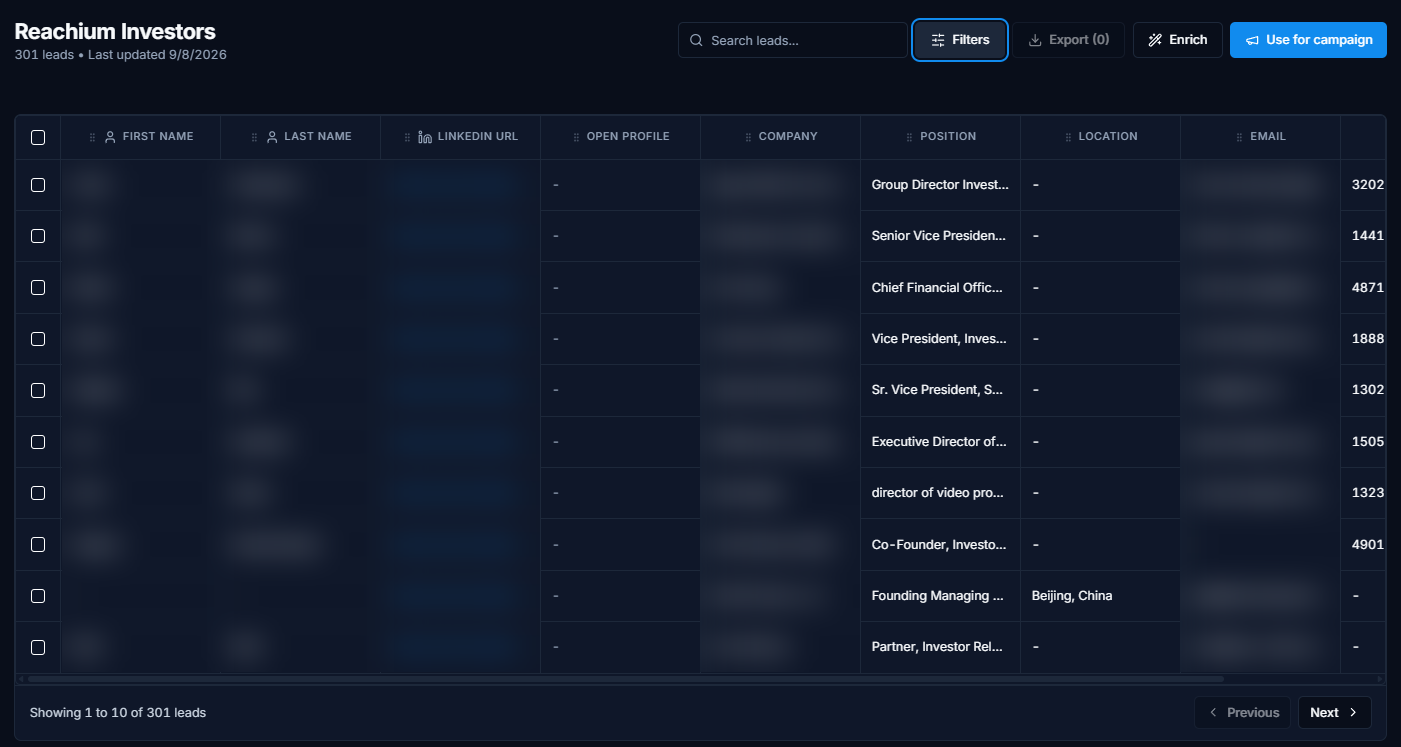
One list, 301 rows, one buyer. Names hidden.
Mistake 2: the fake compliment
"Love your content, would love to connect" is the most common first line on this platform. It has never booked anybody a call.
The reader has seen it forty times this month. It signals a template before your second line gets a chance.
Bad: Hi Sarah, love your content! Would love to connect and hear more about what you're building at Northwind.
Good: Sarah, you posted last week about your SDRs spending half their day in the CRM instead of selling. That is the exact thing we keep hearing from teams your size.
The second one is not cleverer. It is just evidence that a human looked.
The first line rule that replaces the compliment
One true sentence about them that a template could not have produced.
That is the whole rule. It has to be something you could only write after looking at their profile, their post, or their company for thirty seconds.
Three places it is always hiding:
Their last post, if it is about a problem rather than an announcement.
Their headline, when it says something more specific than their job title.
A trigger event: a funding round, a job posting, an office opening, a title change.
If none of those give you anything, that person does not belong on the list. That is a list problem, not a writing problem.
Mistake 3: the pitch in message one
Nobody buys from a stranger on a Tuesday afternoon.
Message one has exactly one job: earn message two. Everything you want to say about what you do belongs after they have said something back.
Bad: Hi Marcus, we help B2B SaaS companies book 30 to 50 qualified meetings a month using AI-powered LinkedIn outreach with zero ban risk. Do you have 15 minutes this week to see how it works?
Good: Marcus, saw you are hiring two SDRs. Are you building the outbound team out, or filling gaps?
The second one is short enough to answer from a phone in a lift. That is the bar.
Mistake 4: the ask that is too big
A calendar link in the first message asks thirty minutes from somebody who met you nine seconds ago.
A question asks for eight seconds. The calendar link is message three, after they have told you something.
Bad: Would you be open to a 30 minute call Thursday or Friday to walk through this? Here is my calendar: [link]
Good: Is that something you are handling in house right now?
Escalate one step at a time. Question, then answer, then a specific offer that fits what they just told you. Trying to do all three in one message is why most outbound fails.
Mistake 5: silence after the accept
This is the one that costs a reply you had already earned.
Half of all the replies we measured landed within 17.7 hours of the connection being accepted. Not 17.7 hours of the message being sent. Of the accept.
That window is when you exist to them. They clicked accept, your name was on their screen, they had a second of context about who you are. Answer four days later and you are a stranger again, sending an unprompted message to somebody who has forgotten why they connected.
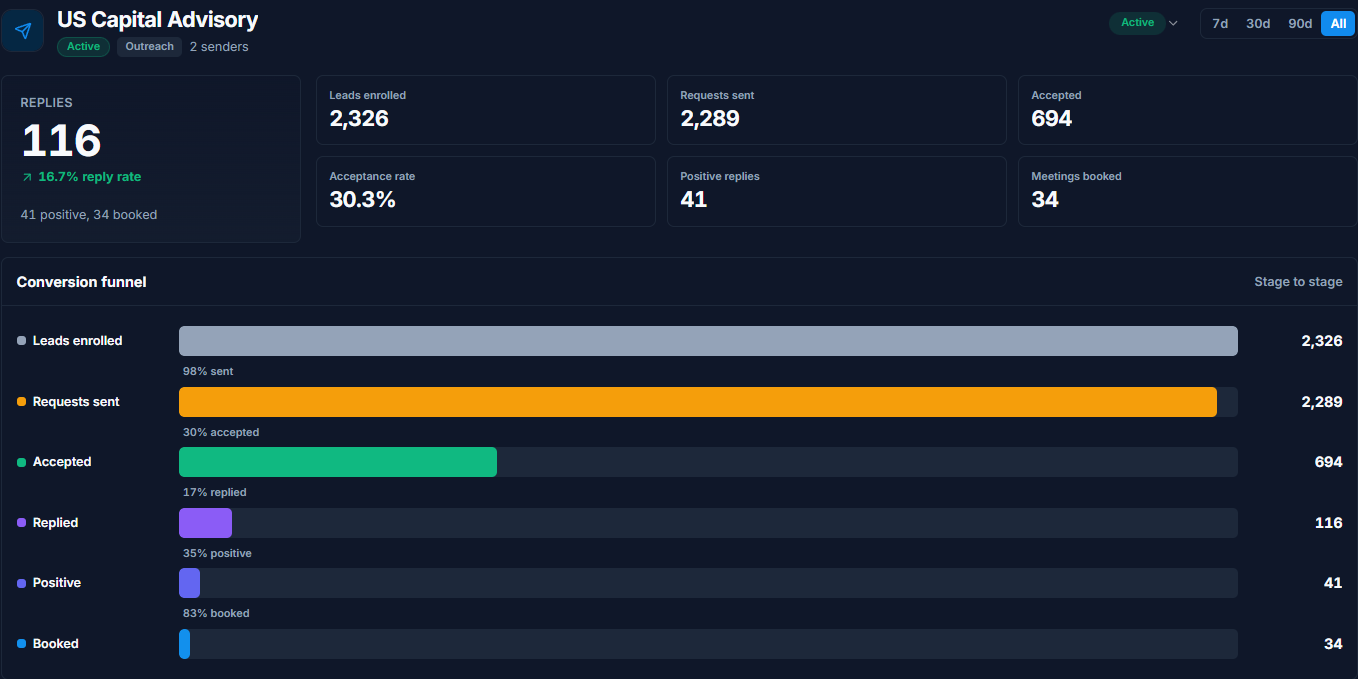
One campaign, all time: 2,289 requests, 694 accepted, 116 replies, 34 meetings booked. Booked means a call on the calendar.
What goes inside the 17.7 hour window
Not a pitch. Not a calendar link. One short message that references the reason you connected and asks one thing.
Thanks for connecting, [First name].

I reached out because [one true sentence about them: their post, their
hiring, their announcement].

[One question they can answer in a sentence].
Under 300 characters. One question mark, not three. No link.
If you have already missed the window on a batch of people, the four words at the top of this document are how you restart them.
Handing this to AI without breaking the account
Every one of these five mistakes can be fixed faster with AI in the loop. Every one of them can also be made worse, at volume, silently.
The split is simple. AI does the work that is slow. You do the work that carries judgement.
The four jobs worth handing over
Job 1: draft the list. The slowest step and the one that pays the most. Never accept it unchecked.
Find me 300 [title] at [industry] companies with [size] staff in [country]
who posted on LinkedIn in the last 30 days.

Show me the first 20 with their headline and last post so I can check the
filter before you build the rest.
Job 2: the first pass on 300 messages. One per person, written off their actual profile rather than a template with the name swapped in.
Write a first connection message for each person on this list.

Rules: under 300 characters, no pitch, no calendar link, no compliment.
Line 1 is one true sentence about them from their profile or last post.
Line 2 is why that made me reach out.
Line 3 is one question they can answer in a sentence.

My voice: [paste three messages you have actually sent].

Show me 10 before you write the rest.
Job 3: triage the inbox. The job people quietly stop doing around message forty.
Go through my LinkedIn inbox and sort it into three groups.

Hot: asked about price, timing, or how it works.
Warm: replied with interest but no question.
Later: polite no, wrong timing, or out of scope.

For each hot one, show me the thread and draft a reply in my voice.
Short, one question, no pitch.
Job 4: the follow up nobody remembers. The one that runs on a schedule instead of on memory.
Show me every connection who accepted in the last 14 days, has not replied,
and has not been messaged since.

Draft a one line follow up for each one that references the original reason
I reached out. No new pitch.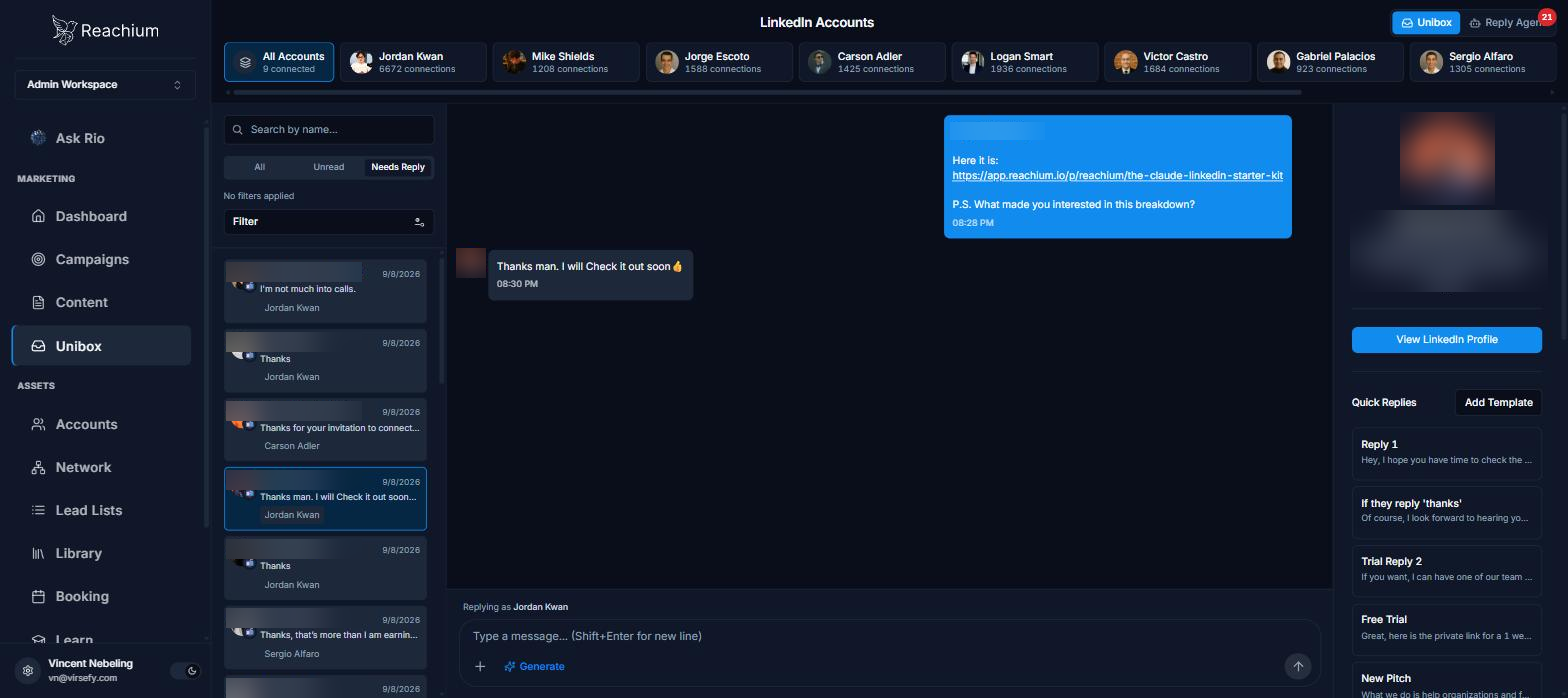
The document delivered by DM, the reply, and the Generate button waiting for a human to press it.
The five things it must never do alone
Build the list unchecked. A wrong list sends perfectly written messages to people who will never buy, and you will blame the copy.
Write the first line from nothing. With no proof and no voice on file, it produces a compliment, which is Mistake 2 at scale.
Send at volume because it can. The daily cap exists for a reason and the account pays for ignoring it.
Answer a buying signal. The moment somebody asks how much, a human takes the thread.
Invent a number. If it cannot be screenshotted, it does not go in a message.
The 90 second approval step
This is the whole safety mechanism and it takes less time than making coffee.
Step 1: Read the first ten messages in the batch, not all 300. If the shape is right in ten, it is right in 300. If two of the ten are wrong, the instruction was wrong, not the batch.
Step 2: Check one thing in each: is line one something a template could have produced? If yes, send it back.
Step 3: Confirm the send rate. 25 a day, spread through the day. Not 300 on Monday.
Step 4: Approve.
Ninety seconds, once per batch. Nothing sends until you have done it.
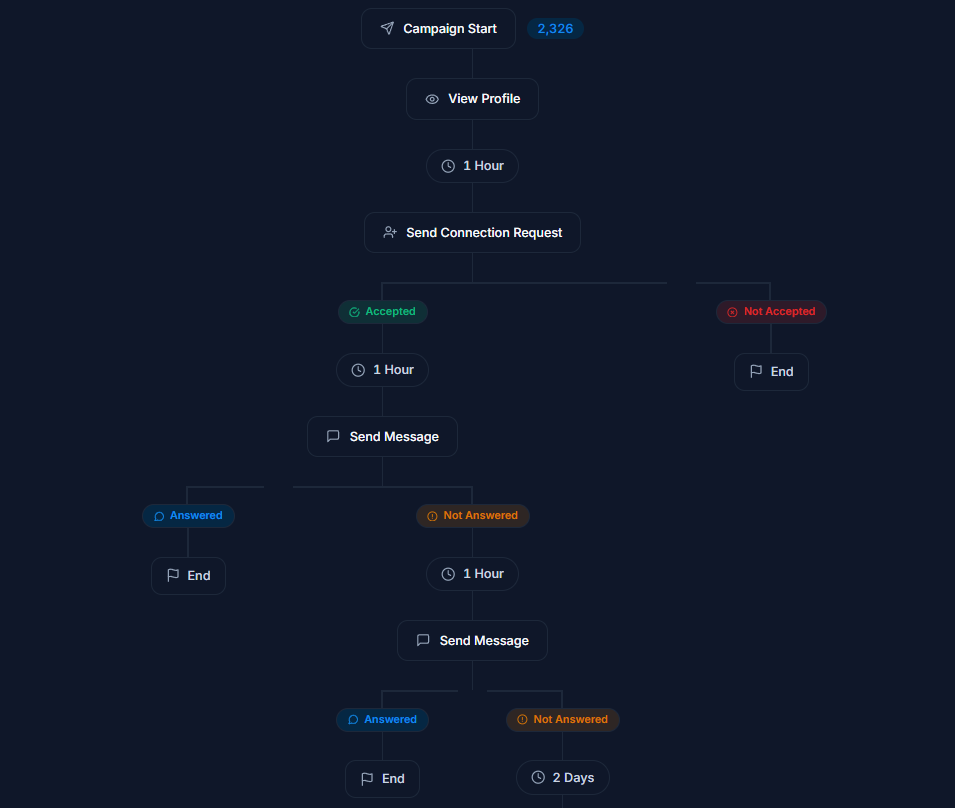
The whole sequence on one screen. Request, one message, one follow-up, stop.
What to change first if you only have an hour
You will not fix five things this week. Fix one, in this order, and stop when the hour is up.
Minutes 0 to 20. Score your current list against the four filter test. If it scores under 3, rebuild it. Nothing below this line matters until it passes.
Minutes 20 to 35. Rewrite line one of your connection message so it could not have been produced by a template. One sentence.
Minutes 35 to 45. Delete the calendar link from message one and replace it with a question.
Minutes 45 to 60. Open every connection accepted in the last two weeks that you never messaged, and send the four word restart or the 17.7 hour message.
That last fifteen minutes usually produces the first reply, because those people already said yes to you once.
Your first 48 hours
Score your list against the four filters and write the score down
Rebuild the list if it scored under 3
Rewrite the first line of your connection message
Remove the calendar link from message one
Send the four word restart to every thread that went quiet
Set the daily send rate to 25 and leave it there
Set a reminder to check the inbox at the same time every morning
The four week ramp
Week 1. List rebuilt, message rewritten, sending at 25 a day. Acceptance is the only number to watch. Anything under 20 percent is a list problem.
Week 2. First replies land. Answer inside the day, every day. Do not change the copy yet, you do not have enough sends to judge it.
Week 3. Around 200 sends in, you can read the numbers. Now change one thing at a time and let an A/B test name the winner instead of guessing.
Week 4. The inbox becomes the job. This is the week most people go quiet, and it is the week the compounding starts.
For context on what the far end looks like: across our accounts we have seen 36.5 percent acceptance over 34,056 requests, roughly one meeting for every 70 requests sent, and 1,022 meetings booked in 12 months. Those are our numbers on our lists, not a promise about yours. Use them as a shape, not a target.
What we promise
You approve everything. No message goes out that you have not read the shape of.
The cap holds. 25 requests a day per account, spread through the day. We do not push it because the account is the asset.
It runs on the official API. Nothing is clicking around your browser at 2am, which is why the account does not get restricted.
Nothing gets invented. If a number cannot be screenshotted, it does not go in a message.
If you would rather not do this yourself
Every part of this document is something you can run on your own, and plenty of people do.
If you would rather have it built with you, book 20 minutes. We will look at your real account, score your real list against the four filters, and rewrite the first line of your real message on the call. You will leave with the fix whether or not you ever become a customer.
Or sign up now and run it yourself.
- Jordan Kwan, founder of Reachium