The 90 Day LinkedIn Takeover Blueprint
The week-by-week plan that takes a profile from an empty room to a working machine. Without ads, without posting daily, and without a single growth hack.
ps - if you would rather we build this on your account with you live, book a setup call with the Founder of Reachium.
Don't have a Reachium account yet? Make your Reachium account here
⭐️ Trusted by 2,500+ sales teams, 1,022 meetings booked across Reachium accounts in the last 12 months ⭐️
It is not luck
When someone's LinkedIn is clearly working, the reflex is to assume timing, or an audience they had before, or one post that happened to land.
I have looked at a lot of accounts that work and a lot that do not. The difference is never talent and it is never luck. It is a sequence, and the accounts that work ran the sequence in order.
What most people do: post about whatever they thought about that week, put a link in the body, publish, close the tab, and check impressions the next morning. Then they do it again, daily, for three weeks, and quit.
What the accounts that work do instead: fix the destination first, pick one subject and hold it, publish less and stay for the first hour, and run outreach alongside the posting so the content has somewhere to send people.
The 90 days is not how long results take. It is how long it takes to build the machine that produces them.
The four things to stop doing first
Before the plan, the leaks. Every one of these costs more reach than any hook ever earned, and most struggling accounts are doing all four at once.
1. Stop putting links in the body. The feed wants people to stay on LinkedIn. A link in the post tells it you are sending them away, and the studies that have measured it put the cost anywhere from a fifth of your reach to more than half. The "link in the first comment" trick is now penalised as well. If a link has to exist, publish first and edit it in an hour later, or make the resource something people comment for.
2. Stop posting daily filler. Three good posts beat six weak ones. Dwell time is a ranking signal, and a post people skim in two seconds teaches the feed that your content does not hold attention. That lesson carries over to your next post.
3. Stop writing for everyone. The 2026 feed is ranked on an interest graph. It shows a post about one problem to the people who have shown interest in that problem. A post about "growth" is about nothing, so it goes to nobody in particular.
4. Stop publishing and leaving. The first hour decides how far a post travels. Replies from the author inside that hour are the cheapest reach on the platform. Only post when you can stay for 60 minutes.
None of that is writing advice. All four are distribution mistakes, and people make them for years while blaming their copy.
How the feed actually decides
Three rules explain most of what you will see over the next 90 days.
The one-subject rule. The feed does not check your follower count before deciding who sees a post. It checks what the post is about and who has engaged with that subject before. A first post from a new account on a clear subject can out-reach a 50,000 follower account writing about nothing in particular. So the early months are not about building an audience. They are about teaching the system what you are for. Every off-topic post resets that lesson.
The first-hour rule. Early engagement, especially comments and author replies, tells the feed a post is worth testing on a wider circle. A small account has an unfair advantage here: with few comments, you can answer every one of them, properly, in full sentences, within minutes. Do that while you still can. Big accounts cannot.
The save mechanic. A save is worth several likes to the ranking, and saved posts get pushed into the feeds of people who do not follow you. Posts get saved when they are useful later: a checklist, a template, a number someone will want to quote. Write at least one post a week that somebody would want to find again.
Days 1 to 7: fix the destination
Everything after this week sends traffic to your profile. If the profile is not ready, the traffic bounces and you never find out it happened.
The headline. Not a job title. Who you help, with what, in one line a stranger can understand in four seconds.
Headline formula:
I help [one specific buyer] [get one specific outcome] [without one specific pain].

Example:
I help B2B founders book 10+ sales calls a month from LinkedIn without a sales team.
Bad: "Founder & CEO at Acme | Growth | AI | Building the future"
Good: "I help agency owners run 10 client accounts on LinkedIn without hiring"
The about section. Written to that one buyer, in the second person, and short. Their problem in the first two lines, what you do about it, one proof point, one way to reach you.
The featured slot. One free resource, no email gate, no form. It is the thing a stranger reads before deciding whether you are worth a reply. If you have nothing yet, a one-page checklist about the problem you solve is enough to start.
Pick the one subject. Write it down. One problem, for one kind of person, that you can write about from forty angles. You will hold it for the full 90 days.
Week 1 checklist:
Headline rewritten with the formula
About section rewritten to one buyer, second person
One free resource in the featured slot
The one subject written down and taped somewhere you can see it
Profile photo that looks like a person you would reply to
Weeks 2 to 4: build the list and write two messages
Content warms the room. Outreach fills it. Both engines start here, and the list comes first because a great message to the wrong list gets ignored.
Build one list. 300 people, not 3,000. One title, one company size, one trigger event (hiring for the role you replace, a funding round, a new office). Three hundred right people beat three thousand approximately right people every time.
If Reachium is connected to Claude, this is one sentence:
Search the database for [title] at [industry] companies with [size] employees in [region] who posted or commented in the last 30 days. Show me a sample of 10, then build a list of 300.
Write two messages. The connection note and one follow-up. That is all. Not a five-step sequence.
Connection note (under 300 characters, no pitch):
Hi [first name], saw your post on [specific thing]. I work with [buyer type] on [problem]. Curious how you are handling it at [company]?

Follow-up (3 days after they accept, still no pitch):
Thanks for connecting, [first name]. I put together a short [resource name] on [problem] a while back. Want me to send it over?
Bad: Ten lines about your company, three bullet points of features, and a calendar link.
Good: Four lines, one true observation, one question they can answer with one word.
Start sending. 25 connection requests a day, no more, every working day. That cap is what keeps the account alive. Across our accounts it produces roughly one booked meeting per 70 requests once the list is right.
Weeks 2 to 4 checklist:
One list of 300 built against a title, a size and a trigger
Connection note written, under 300 characters, no pitch
Follow-up written, offers the resource, no calendar link
25 requests a day going out
First three posts written, all on the one subject
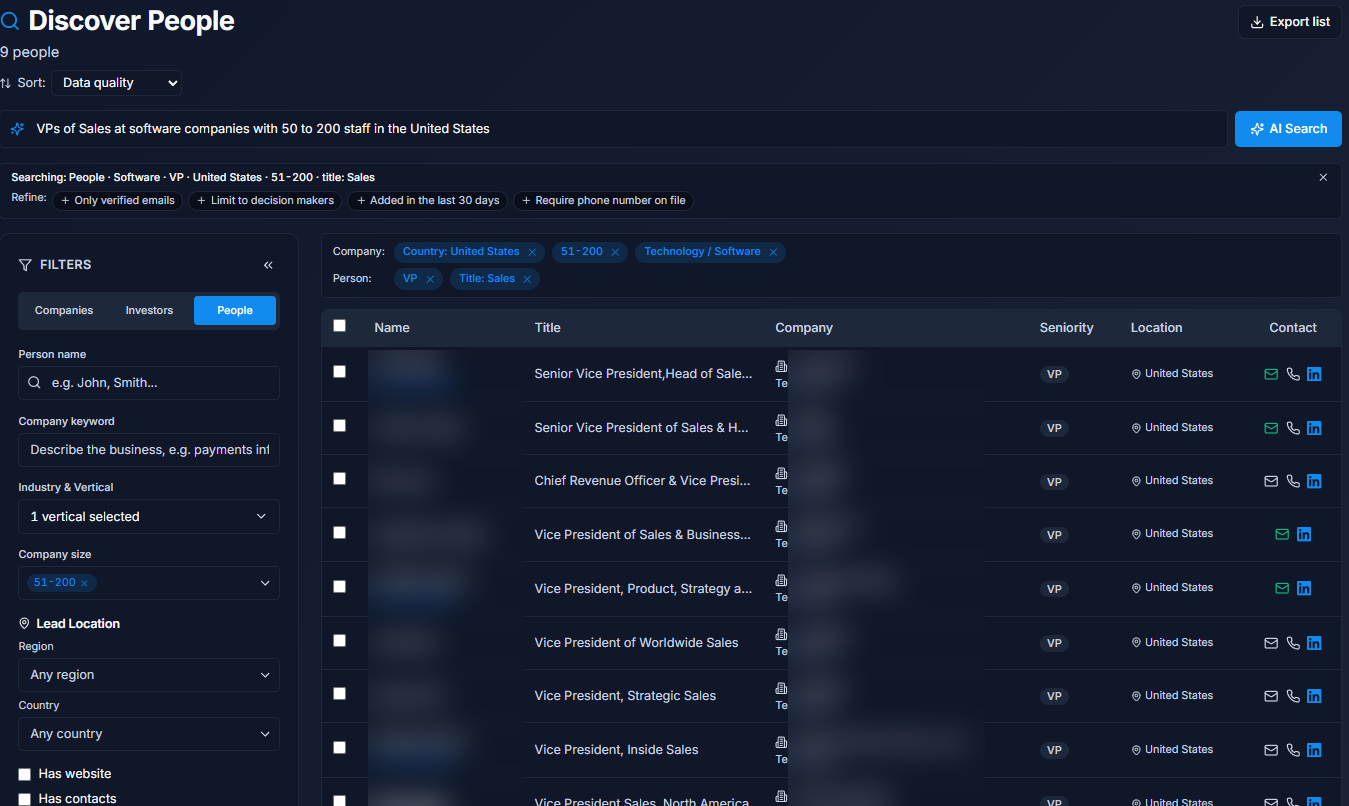
One sentence became the filters. Check the sample before you build 300. Names hidden.
Weeks 5 to 8: both engines running
By now the profile is ready and the list is warm. This is the block where the rhythm gets set.
The weekly rhythm. Three to five posts a week, spaced at least 18 hours apart, all on the one subject from different angles. A useful mix for a week:
One post that teaches a step. This is the one that gets saved.
One post with a real number from your own work.
One post that takes a position people can disagree with.
One post that gives something away for a comment.
The first hour, every time. Post only when you can stay. Reply to every comment in full sentences. Ask a question back. The thread is the post's engine.
Outreach keeps running underneath. 25 a day. Reply to every accept inside 24 hours; half of all replies we measured came within 17.7 hours of the connection being accepted, so the window is short. Anyone who commented on a post and is not yet connected gets a request that week.
Reruns are allowed. A post that worked can come back with a new angle after six to eight weeks. Nobody remembers, and the people who saw it the first time are a fraction of who will see it now.
Weeks 5 to 8 checklist:
Posting days fixed in the calendar, 18 hours apart, with the hour after each blocked for replies
Every comment answered in full sentences inside the first hour
Every accept answered inside 24 hours
Every commenter who is not yet connected sent a request that week
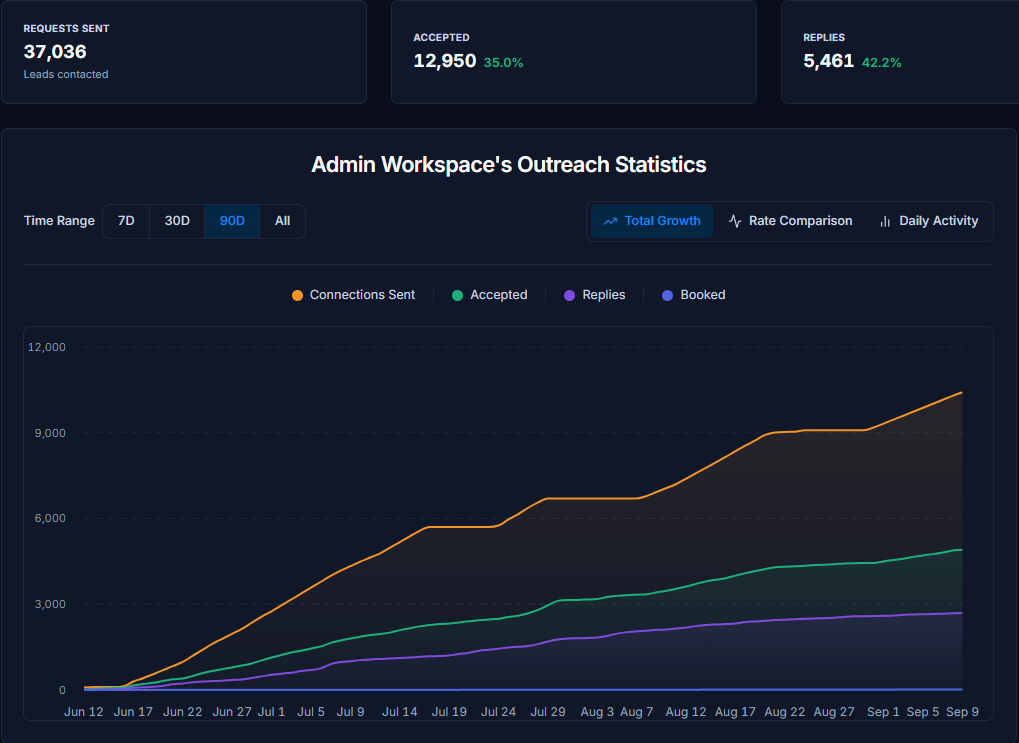
Ninety days of requests, accepts and replies across our accounts. The line only climbs like this when the cap holds.
Weeks 9 to 12: the compounding phase
This is the block where most people go quiet, because they are tired and the curve has not bent yet. It is also the block where it bends.
What is happening under the surface: the feed has learned your subject. Your saved posts are still circulating. The 300 people from your list have seen eight weeks of posts about their problem. Your featured resource has been read by people you have never spoken to.
What to do in weeks 9 to 12:
Keep the rhythm exactly the same. Do not add posts, do not change subject, do not try video.
Go back through everyone who liked or commented in weeks 5 to 8 and is now connected. Send them the resource, or a question about their reply. That pool is the cheapest audience you will ever message.
Reply to inbound the same day. Inbound starts here and it dies in an unanswered inbox.
Write one post that is the whole 90 days in a single list. It will be your most saved post so far.
The warm pool message (to someone who engaged in weeks 5 to 8 and is now connected):
Hey [first name], you commented on my post about [subject] a few weeks back. I wrote the whole thing up as a one-pager since then. Want me to send it?
Most people quit two weeks before the bend. Weeks 9 to 12 are those two weeks.
What to measure on day 30, 60 and 90
Impressions are not on this list on purpose. They tell you how many strangers scrolled past you, and they can triple while nothing that pays moves.
Number | Day 30 | Day 60 | Day 90 |
|---|---|---|---|
Profile views per week | Up from day 1 | Roughly double day 30 | Still climbing |
Connection requests received per week | A handful | Weekly, without asking | Daily |
Engagement rate (reactions + comments / impressions) | Whatever it is, write it down | Higher than day 30 | Higher than day 60 |
Leads generated (comments for a resource, DMs, booking clicks) | First ones | Weekly | Predictable |
These are directions, not promises. Your absolute numbers depend on your market and your list. The direction is what tells you the machine is working.
If profile views are flat at day 30, the headline or the subject is the problem. If profile views climb but connection requests do not, the about section or the featured resource is not doing its job. If both climb and leads do not, you are not giving anything away for a comment, or you are not answering fast enough.
The curve, month by month
So you know what normal looks like and do not panic at the flat part.
Month 1. Flat. Posts get a few dozen impressions. Outreach acceptances start, a few replies, maybe a first conversation. It feels like talking in an empty room. This is normal and it is not a signal.
Month 2. Still mostly flat, with one or two posts that do noticeably better than the rest. Those are the feed testing your subject. Replies from outreach are now weekly. Profile views are up. First inbound comment that is not from a friend.
Month 3. The bend. One post travels well beyond your followers. Connection requests start arriving without you sending any. A stranger books a call and says they have been reading for a while. Outreach and content start sending people to each other.
The curve does not go up gently. It sits flat for months and then bends. The flat part is not the machine failing. It is the machine being built.
Your first 48 hours
Rewrite the headline with the formula above
Rewrite the about section to one buyer, in the second person
Put one free resource in the featured slot, even a one-pager
Write down the one subject
Build the list of 300, or the first 100 of it
Write the connection note and the follow-up
Draft your first three posts, all on the one subject
Block one hour after each posting time in your calendar for replies
What we will not promise
We will not promise a number by day 90. Your market, your list and your subject decide that, and anyone who gives you a follower count in advance is guessing.
We will not tell you to post daily, run engagement pods, or send more than 25 requests a day. All three trade your account's long-term reach for a short-term number.
We will not tell you content alone books meetings. It does not. Content warms the room. Messages fill it.
Two things we will promise. Nothing leaves your account that you have not approved. And the 25 a day cap does not move, on any plan, for any price.
If you would rather not run this by hand
Everything in this document works with a LinkedIn account, a notes app and a calendar reminder. Plenty of people run it that way.
What Reachium does is the part that stops depending on you remembering: the list built from one sentence, the two messages sent inside the limits, every accept and reply in one inbox with the ones that matter flagged, the posts scheduled 18 hours apart, and the comment-for-a-resource delivery running while you sleep. Claude runs all of it from one conversation.
Either way, fix the headline this afternoon. It is free, it takes eleven minutes, and everything else in here sends people to it.
- Jordan Kwan, founder of Reachium