What the LinkedIn Feed Actually Ranks in 2026
The mechanics under the advice. Why posting more stopped working, and what to do on the days you post.
ps - if you would rather we build the content engine with you, book 20 minutes with the team. We will read your last ten posts live and tell you which ones spent attention instead of earning it.
Not using Reachium yet? Sign up here.
One post built on the shape in this document did 45,278 impressions and 1,080 comments.
Steal this first
Open your last ten posts. Write down the subject of each one in two words.
If you have more than three different subjects in that list, you have found the reason your reach is flat, and it has nothing to do with your writing.
The feed cannot promote what it cannot categorise. Ten subjects across ten posts is ten different signals, and the result is that you get shown to nobody in particular.
That is the whole quick win. The rest is why.
The two things that actually decide reach
Neither of them is your follower count.
One: the interest graph. The feed works out what your posts are about, then shows them to people who have shown interest in that subject. Not to your followers. To people interested in the topic.
Two: dwell time. How long somebody actually stays on the post once it is in front of them. Not whether they liked it. How long they stopped.
Everything else that gets written about the algorithm is downstream of those two.
What the interest graph is measuring
It is reading the subject of your post, not your job title and not your bio. It builds a picture of what your account is for out of what you keep publishing about.
Three things follow from that, and they are all counterintuitive.
A brand new account can reach further than a 50,000 follower account, if the new account is clearly about one thing and the big one is about everything.
Followers are a distribution bonus, not a gate. They are not who decides your reach.
Every off topic post is not neutral. It is a contradictory signal that makes the picture blurrier.
How long it takes to learn you. In our experience it is measured in posts, not days. Somewhere around fifteen to twenty posts on one subject is where accounts start getting shown to a consistent audience. At three to five posts a week, that is a month of staying on topic before the picture resolves.
That is the real reason the advice is to pick one subject for 90 days. It is not discipline for its own sake. It is that you have to publish enough on one thing for the picture to form, and every detour resets part of the work.
Dwell time, and the three post shapes that hold it
Dwell time is the reason two posts with identical reach can perform completely differently, and it is the reason AI drafted posts underperform even when they read well. Smooth, even writing finishes fast. Finishing fast is a signal.
Three shapes hold attention reliably.
Shape 1: the numbered contents post. A promise, then a numbered list of what is inside. The reader scans the list to find the item they care about, which takes time, and they often scroll back up. This is the highest dwell shape we run.
Shape 2: the bad versus good pair. Show the wrong version, then the right one. The reader compares them, which is slow by nature. Nobody skims a comparison.
Shape 3: the specific scene. One moment with real detail. A number, a day of the week, a thing somebody said. Specificity slows a reader down because it is not predictable, and unpredictable text cannot be skimmed.
What kills dwell: an opener that could have been written by anyone, a middle that restates the opener, and a post that ends exactly where the reader expected it to.
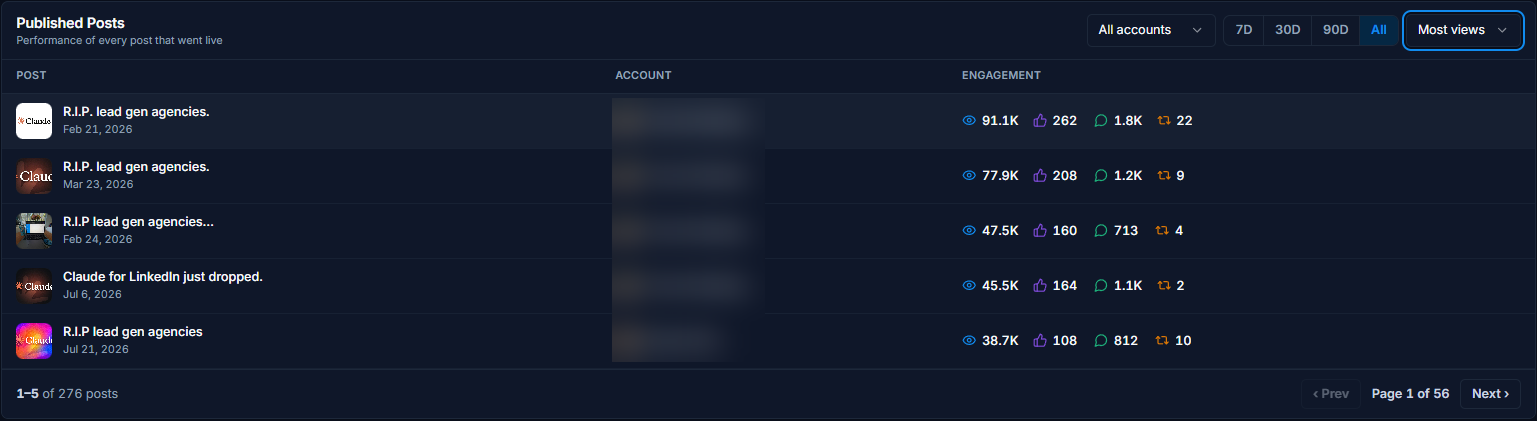
Five numbered-contents posts, 300,000 views between them.
Saves, and why one save is worth more than a handful of likes
A like is a reaction. A save is a declaration that this was useful enough to come back to, and the feed treats it accordingly.
The part people miss: a save pushes your post toward people who do not follow you. It is the single cheapest way to reach outside your own network without paying for it.
You do not get saves by asking for them. You get them by writing something with a list in it that somebody will need again. Frameworks get saved. Templates get saved. Opinions do not.
The four distribution mistakes, ranked by what they cost
These are ranked worst first. All four are things somebody told you to do.
Mistake 1: writing about everything. The most expensive habit here, because it undoes work rather than just failing to add to it. Every off topic post blurs the picture the feed has built of your account, and the next on topic post has to rebuild it.
Mistake 2: posting daily. Three real posts beat six filler ones. The weak posts are not free. They teach the system that your content does not hold attention, and that lesson applies to the good ones too.
Mistake 3: links in the body. A link in the post body still costs reach, and dropping it in the first comment is not the workaround it used to be. If a link has to exist, publish first, then edit it in an hour later.
Mistake 4: publishing and leaving. The first hour decides the post. Author replies inside sixty minutes are the cheapest reach available on this platform and almost nobody stays around for them.
Bad week: Seven posts, four subjects, a link in every body, published from the train and never opened again.
Good week: Three posts, one subject, no links, the author in the comments for the hour after each one.
Notice that none of these are writing advice. You can fix all four without changing a single sentence of your copy.
The first hour routine
Six lines. Do not post unless you can be around for the hour after.
Publish, then read the first line back on your phone. If it does not survive being the only thing visible, edit it now.
Reply to every comment in full sentences. Not "thanks", an actual answer.
Ask one question back in at least half your replies. A reply that continues is worth more than a reply that closes.
Do not reply to yourself with a link or a "see more here". That is a link in the body wearing a disguise.
Check the post again at 45 minutes and clear anything new.
Stop at the hour and leave it alone.
That is the entire routine. It is worth more than any hook you will write this month.
The weekly rhythm
Three to five posts a week, spaced at least 18 hours apart. Closer than that and they compete with each other for the same audience.
One subject. The same problem from a new angle, for 90 days.
One shape per post, picked from the three above. If you cannot say which one you are writing, you are writing filler.
Here is the planning prompt we use.
Here are the last 10 posts I published: [paste them].

Tell me:
1. What subject the feed would conclude this account is about.
2. Which posts contradict that subject.
3. Which of the three shapes each post used, or none.
4. Five post ideas on the one subject, each with the shape named.

Do not write the posts yet.
Run it once a month. It is the fastest audit of your own account you can do.
What to check on day 30, 60 and 90
Impressions are not on this list, on purpose. Impressions tell you how many strangers scrolled past you slightly slower than usual.
Day 30. Profile views. Somebody read a post and went to check who you are. This is the first number that moves when the interest graph starts resolving, and it moves before anything else does.
Day 60. Connection requests received, and saves. Interest strong enough to act on. If profile views moved at day 30 and this has not moved at day 60, your posts are interesting but your profile is not converting the visit.
Day 90. Leads generated. Anyone who asked you for something: a comment on a resource post, a message, a booking click. This is the only one that is revenue shaped.
What a stall actually looks like
There are three different stalls and they need three different fixes. Telling them apart is most of the skill.
Flat impressions, flat profile views, flat everything. The interest graph has not resolved. You are almost certainly still on more than one subject. Fix the subject, not the writing.
Impressions climbing, profile views flat. You are reaching people who are not your buyer. Usually this means you are writing about the craft rather than the problem. A VP of Sales does not want a post about writing hooks, they want a post about why their team's replies dried up.
Profile views climbing, requests and leads flat. The posts are working and the profile is not. The headline says a job title instead of who you help and with what, or there is nothing free in the featured slot for a stranger to take away.
The flat stretch is normal and it is longer than anyone tells you. The curve does not rise gently. It sits flat for weeks and then bends. Most people quit two weeks before the bend, which is why the advice to post more exists at all: it feels like doing something during the part where nothing is visibly happening.
Your first 48 hours
Write down the subject of your last ten posts in two words each
Pick the one subject you are going to own for 90 days
Rewrite your headline so it says who you help and with what
Put one free resource in your featured section
Remove links from the body of your next post
Block the hour after your next post in your calendar
Write down today's profile views so you have a day zero
What we promise
No engagement bait. Pods, "Agree?", tag-someone posts and comment ladders are penalised now and they cost more than they return.
No invented numbers. Every figure in this document is from our own accounts. If a number cannot be screenshotted, we do not publish it.
No promised timeline. We can tell you the shape of the curve. We cannot tell you the week yours bends, and anybody who does is guessing.
If you would rather not do this yourself
You can run all of this on your own. The routine is the whole product and it is written above.
If you would rather have it built with you, book 20 minutes. We will read your last ten posts on the call, tell you what the feed currently thinks your account is about, and rebuild one post live from raw material to finished draft.
Or sign up now and run the content engine yourself.
- Jordan Kwan, founder of Reachium